

Showing posts with label Twitter. Show all posts
Showing posts with label Twitter. Show all posts
Wednesday, 29 April 2020

Wednesday, 26 February 2020
Thursday, 12 July 2018
South African influencers- how people have cashed in by turning social media into a marketing platform
There are a number of reasons that social media influencers are so
important to many companies marketing strategies, writes Cheyenne
Pillay.

Social media has become a way to share your life and experiences with friends and strangers alike. From days at the beach to work events, logging onto social media networks such as Facebook, Instagram and Twitter will give you a peek into the daily lives of millions of users worldwide.
It is a common assumption that in the coming years, it will be a common occurrence for more and more influencers to emerge and make substantial incomes through digital content creation and marketing, especially with new tools and forums being created to assist them.
Source
Social media has become a way to share your life and experiences with friends and strangers alike. From days at the beach to work events, logging onto social media networks such as Facebook, Instagram and Twitter will give you a peek into the daily lives of millions of users worldwide.
Some of these users have now found a way to cash in by becoming what is known as a social media influencer, and as of right now, South Africa, alone, has thousands of them.Social media influencers do exactly what the name suggests, they influence. There are many types of influencers, such as beauty, fashion and technology influencers, and the amount of brands queuing up to work with them is growing by the day.
Influencers marketing, which is the use of social media personalities to market products, reached around $2 billion worldwide in 2017, and is estimated to hit around $10 billion within the next five years, according to Cape Town digital content strategist, Clerissa Visser.Aside from small local businesses leaning on influencers for marketing, bigger brands such as Dove, Revlon, etc are continuously adding bloggers and influencers to their PR lists, and on any social media network, you regularly see influencers reviewing or advertising various products and services.
For categories such as beauty, the influencer market is booming. Mass services such as Beauty Bulletin and Ruby Box act as a form of middle man in connecting beauty influencers with beauty brands.
It is a common assumption that in the coming years, it will be a common occurrence for more and more influencers to emerge and make substantial incomes through digital content creation and marketing, especially with new tools and forums being created to assist them.
Source
Wednesday, 4 July 2018
Twitter launches its Ads Transparency Center, where you can see ads bought by any account
Twitter is unveiling the Ads Transparency Center that it announced back in October.
This comes as Twitter and other online platforms have faced growing political scrutiny around the role they may have played in spreading misinformation, particularly in the 2016 U.S. presidential election.
For example, House Democrats recently released thousands of Russian-funded political Facebook ads, and Facebook will reportedly release its own ad transparency tool this week. (In fact, as this story publishes, I’m at a Facebook press event focused on ad transparency.)
Twitter says that with this tool, you should be able to search for any Twitter handle and bring up all the ad campaigns from that account that have run for the past seven days. For political advertisers in the U.S., there will be additional data, including information around billing, ad spend, impressions per tweet and demographic targeting.
Everyone should be able to access the Ads Transparency Center, no login required.
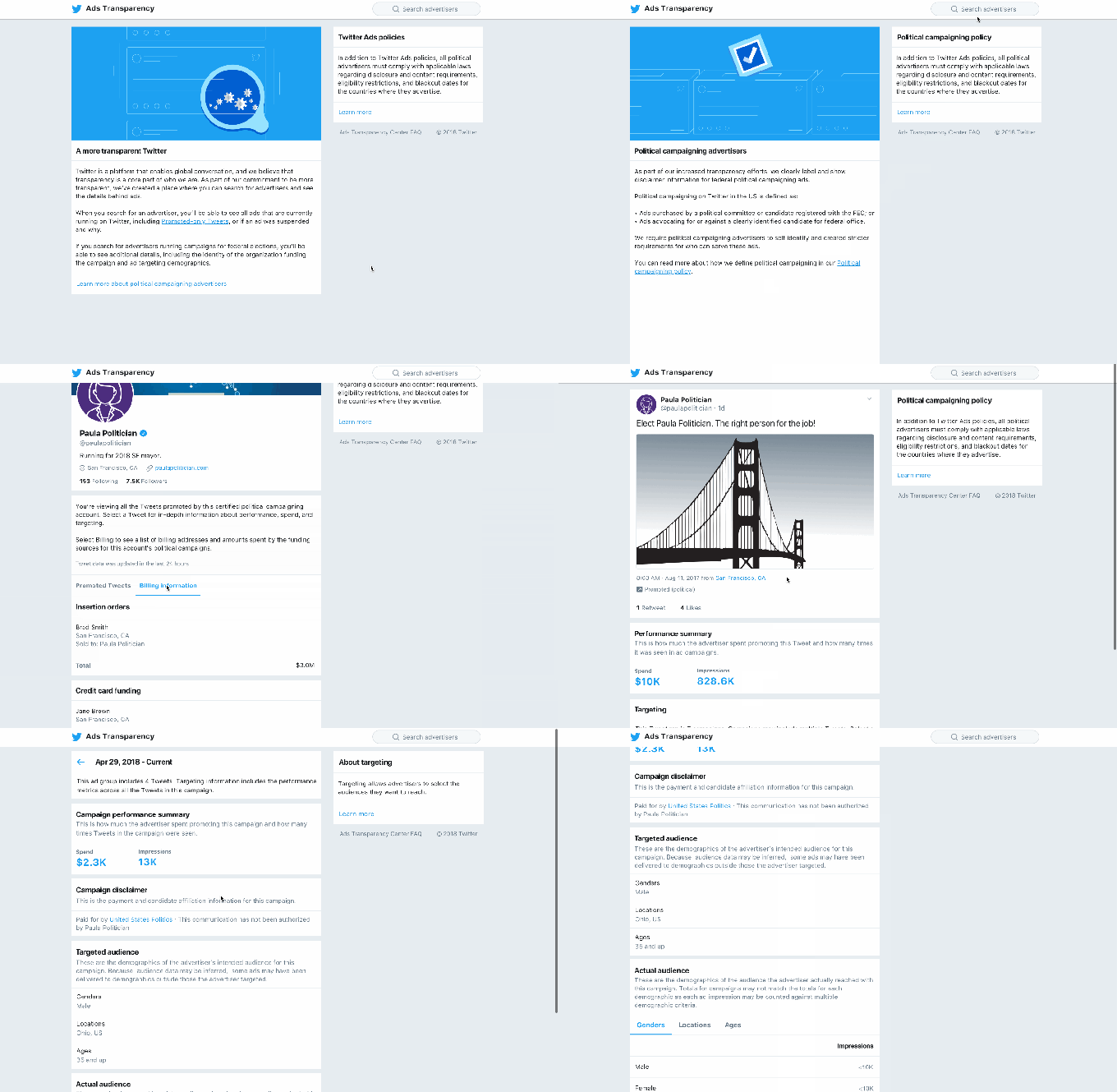
As part of the political ad guidelines that Twitter announced last month, the company says it will be visually identifying ads that are tied to federal elections in the United States. Over time, it plans to develop a policy specifically around “issue ads” (i.e. political ads that aren’t explicitly promoting a candidate) and looking for ways to expand these policies internationally.
“We are doing our due diligence to get this right and will have more updates to come,” writes Twitter’s Bruce Falck in a blog post. “We stay committed to iterating and improving our work in this space, and doing what’s right for our community.”
Source
Image Credits: TechCrunch
This comes as Twitter and other online platforms have faced growing political scrutiny around the role they may have played in spreading misinformation, particularly in the 2016 U.S. presidential election.
For example, House Democrats recently released thousands of Russian-funded political Facebook ads, and Facebook will reportedly release its own ad transparency tool this week. (In fact, as this story publishes, I’m at a Facebook press event focused on ad transparency.)
Twitter says that with this tool, you should be able to search for any Twitter handle and bring up all the ad campaigns from that account that have run for the past seven days. For political advertisers in the U.S., there will be additional data, including information around billing, ad spend, impressions per tweet and demographic targeting.
Everyone should be able to access the Ads Transparency Center, no login required.
As part of the political ad guidelines that Twitter announced last month, the company says it will be visually identifying ads that are tied to federal elections in the United States. Over time, it plans to develop a policy specifically around “issue ads” (i.e. political ads that aren’t explicitly promoting a candidate) and looking for ways to expand these policies internationally.
“We are doing our due diligence to get this right and will have more updates to come,” writes Twitter’s Bruce Falck in a blog post. “We stay committed to iterating and improving our work in this space, and doing what’s right for our community.”
Source
Image Credits: TechCrunch
Saturday, 23 June 2018
Saturday, 9 June 2018
Saturday, 2 June 2018
Thursday, 31 May 2018
8 ways to boost your finances with social media

In Great Britain, 61% of adults used the internet for social networking in 2015, according to the Office for National Statistics, but these sites aren’t just for keeping in touch with far-flung family and friends; they’re increasingly being used to boost your finances; from complaining to companies on Twitter, to selling your wares on Instagram.
Here are our top tips on how social media can help stretch the pound in your pocket.
1. Get your consumer complaints resolved - fast
Twitter and Facebook are fast becoming alternative avenues for complaints. The fact you’ve named and shamed the company in public may even help you to get a quicker response.
The day I wrote this feature, I spotted someone complaining on Twitter to a well-known supermarket that their bacon sandwich was literally taking the bacon by not including any of the streaky stuff – a picture of the offending meal was posted for all to see.
A mere two minutes later, the supermarket responded by asking for more information and promising the customer they would not be left out of pocket.
I, too, have used Twitter to complain. I once huffed and puffed about a train being cancelled, only for the rail operator to speedily respond telling me how I could claim compensation.
Moneywise’s special projects editor Rachel Lacey has also used Twitter to challenge private parking fines and to track down missing toy parts.
Many banks also have teams on hand 24/7 to answer your questions via social media. Just remember to write directly on the company’s Facebook page or link to their Twitter handle in your tweet to improve your chance of getting a response. And never compromise your identity; don’t post your bank details or other sensitive information online.
2. Look out for a new job
If you want to find a new job, join LinkedIn and set up an online CV, then connect with former colleagues and other professionals in your field. You can also use LinkedIn to search for jobs.
For a localised search, follow your nearest Jobcentre Plus on Twitter for job adverts in your area, and ‘like’ their Facebook pages for updates.
3. Make money selling crafts or unwanted goods
You can sell anything from old clothes to furniture using Facebook. It’s completely free and Facebook doesn’t take a cut of any earnings made. Just find a local sales group in your area, click ‘Sell Something’, fill out the details of what you’re selling with a price, and click ‘Post’.
If you want to save money on postage, stipulate that items are for collection only – just be safe about where you meet the buyer.
Instagram is also a tool for promoting and selling homemade crafts and wares, as it’s all about photos. Caption your picture with relevant hashtags so people can find what they’re looking for.
4. Get money news and tips
Follow the national newspapers, money-saving websites and money-saving blogs on Twitter, and ‘like’ their Facebook pages and you’ll be first to hear of any news. From utility bill price hikes to top savings accounts being launched, if you’re among the first in the know you can be among the first to do something about it.
5. Promote your business

If you’ve got a business, no matter how large or small, social media can be an excellent form of free advertising, as well as a way to interact with your customers and get feedback from them.
Joanne Larner, (above) a 58-year- old osteopath from Rayleigh in Essex, puts part of the success of her first book down to social media. She self- published Richard Liveth Yet – a novel about Richard III set in the present time – on Amazon last May. But she notices a spike in e-book downloads as soon as she mentions the novel on her Twitter account, on her glob, or on her LinkedIn page. When she doesn’t post on social media, her sales go down.
Joanne advises others in a similar position “to find your target audience”.
As she is passionate about the history of Richard III, she regularly chats to like-minded people in relevant Facebook groups and uses this as an avenue to promote her book.
However, she warns that you shouldn’t only use these groups for self-promotion or no one will take an interest. Joanne says you need to actively engage and interact with people.
6. Nab discounts and freebies
Whether you’re heading out for a meal, planning a holiday, or buying a birthday present – try to get a discount first. Follow the likes of @vouchercodesuk and @MSE_Deals on Twitter to arm yourself with the best bargains.
And never miss out on a freebie by following the tweets of @LatestFreeStuff. It says it features samples and freebies given away by Dove, Colgate, Gillette, Fairy, Olay, Boots, Tesco and more.
Alternatively, all of these deals websites have their own Facebook pages, too.
7. Get recommendations for local services
Whether it’s a plumber, electrician or a hairdresser you’re after, type it into the search bar on Facebook alongside your location, and a number of relevant local companies should pop up. Then click on their pages to read more about them, including any reviews people have left.
If you’ve built up a following on Twitter post a comment asking if anyone can recommend services in your area. Or if you are on Facebook, see if there is a group for where you live – these can be a good source of local knowledge.
8. Join in with online forums to discuss and encourage saving money
Forums are a huge online resource where users discuss ideas, post tips, and provide encouragement to each other. Plus you don’t even have to post on forums – you should be able to simply ‘lurk’ and read other people’s comments.
The MoneySavingExpert.com and LegalBeagles.info forums are a great place to start for general money- saving and money-making tips. You can also target specific forums depending on the help you’re after.
Tripadvisor.co.uk, for example, can be a helpful source of holiday saving advice.
Just be aware that people posting may not be experts and their opinions shouldn’t always be acted upon.
Source: Helen Knapman
Source: Helen Knapman
Subscribe to:
Posts (Atom)