Showing posts with label Make money online. Show all posts

Sunday, 15 October 2023

What is a UGC Creator? Steps To Become One

What is a UGC Creator? Steps To Become One + Examples

Learn how to become a top UGC creator and generate engaging content for brands with our expert guide.



Making money on social media is a dream – that’s slowly but surely turning into a reality.

Selling online products/services, brand partnerships, subscription-based models, affiliate programs, influencer marketing, and monetizing off of user-generated content are all part of the UGC creator job.

Interested in learning how to become a UGC creator?


What is UGC?

Before explaining what UGC creator is – let’s cover some basics of what does UGC stand for:

UGC stands for User-Generated Content, a term that refers to a wide range of creative outputs created by everyday individuals rather than professionals.

User-generated content is content related to your brand but created by your real customers instead of employees.


If you are wondering why user-generated content instead of content created the usual way – UGC increases conversion by 10% in an online buying process.

This type of content includes text, images, audio, and video and can be found on numerous digital platforms.

The UGC meaning has become increasingly popular as it allows people to share their unique perspectives and talents with a global audience, often forming online communities and connections.

Furthermore, the growth of UGC has redefined content creation, making it more accessible and inclusive for people from all walks of life.

What is a UGC Creator?

Now, it’s only fair we move on to covering what a user-generated content creator is:

UGC creator is a content creator (as the name says it) who “specializes” in creating content that looks user-generated, personal, authentic, and unique to that person’s style – but of course, it’s sponsored (paid by a brand/company). This content is usually shared on the social media feeds of the creator, and it can be in the form of a photo or a video explaining the features of a certain product, its benefits, etc.


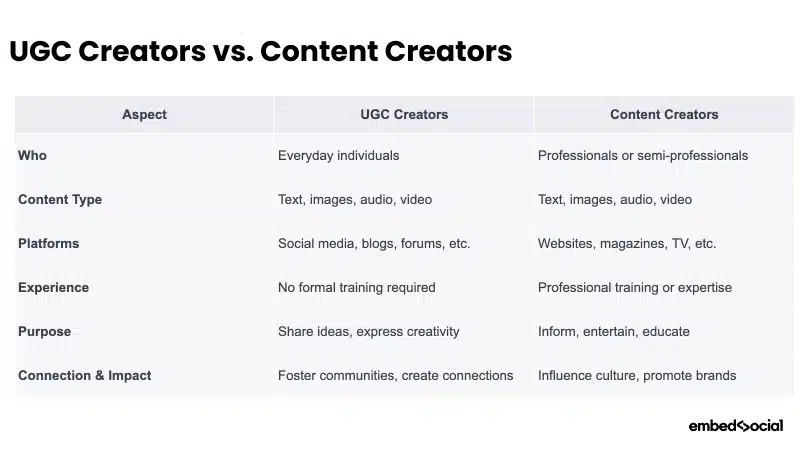
UGC Creators vs. Content Creators

In short, UGC creators are everyday individuals who create content to express their creativity and ideas, while content creators are professionals or semi-professionals who produce content to inform, entertain, or educate.

UGC creators primarily focus on building communities and connections, whereas content creators often aim to influence culture or promote brands. Here is a table with the main differences:


UGC Content Creators vs. Influencers

Often, these creators are confused with influencers who post on their social channels regarding certain products. However, the main difference here is where this content is posted.

Micro-influencers are getting paid to promote products to their target audience/ their community, influencing their purchasing decisions to buy that product. Additionally, brands are paying these influencers for their products to reach a broader audience (the one the influencer has).

UGC creators could create similar content even for that same brand, but the content will be posted on the brand’s channels. In this case, brands are not looking into raising awareness and higher reach of their products/services; instead – they are in it for the authentic feel of the content.

For example, we can take this reel posted on Sephora’s Instagram profile, where a fashion influencer explains her hair routine with versatile products and hair styling tools.

Stephora posting UGC content

Benefits of working with UGC creators

As we’ve already mentioned – user-generated content increases conversions, and here are some UGC stats that confirm this:

  • 75% of marketers claim that UGC makes the brand more authentic
  • 31% of consumers say that ads containing authentic UGC content are more memorable than branded content ads; and that
  • Consumers spend 5,4 hours a day with user-generated content.
  • And finally, marketers don’t need to have a big marketing budget for UGC creation.

As you can tell, brands love user-generated content because it hugely impacts their marketing strategy – but why is that?

User-generated content is so impactful simply because it provides people with social proof. Social proof, on the other hand, works because people trust people and not brands directly. It’s as simple as when you get a certain recommendation from a friend about a certain product, and you’re instantly hooked and ready to try it out.

Content created by UG creators is more engaging, trustworthy, and with higher credibility.

Other than this, content created by UG creators will help you:

  • save valuable time and money (content creation can frequently be expensive and time-consuming to create)
  • showcase your brand is open to communicating with your audience (this type of content will help you create a stronger bond with your audience)
  • personality-based original videos/content with real people are preferred by social media algorithms meaning this content will get a higher reach (get through to more social media accounts and profiles)

Now that we’ve answered the “what” and the “why,” – it’s only fair we move on to the “how” – how to become a UGC creator.

How to Become a UGC Creator? (5 steps)

Becoming a UGC Creator is fairly simple – a huge follower count is not required, nor high engagement levels.

Why? Simply because you’re not influencing people your audience but the audience of the brand you’re creating for (because the content will be published on their profile). Even more, you won’t need special equipment to create this content.

So, what exactly do you need? Here are the exact steps if you’re starting on:

  1. Create your UGC-specific account
  2. Understand the UGC landscape
  3. Plan your UGC strategy
  4. Create high-quality UGC
  5. Build your UGC portfolio
  6. Collaborate and reach out to brands

1. Create your UGC-specific account

Create an account on the platform(s) that align with your content goals. Choose a username that reflects your brand or niche, and complete your profile with a compelling bio and relevant details.

Creating a different account will allow you to separate your personal from your “brand” account for privacy reasons. Additionally, creating an account with UGC usage in the description and/or name will help brands discover you faster and easier.

Once you create your account, you can start following other creators sharing tips, knowledge, and experience about the creator economy, how to make contacts, and how to get your first earnings as a creator.

Don’t be scared to reach out to other creators, and engage with the UGC creator community – you never know with who you might start collaborating.

Skills you need to become a creator:

  • Video and photo creation and editing skills
  • Copywriting for writing cool captions and scripts for creating UGC videos
  • Live communication
  • Research Skills are always a plus
  • Basic marketing knowledge (understanding how sales funnels work + e-mail marketing + how social media channels and algorithms work)

2. Understand the UGC landscape

Now that you have your account, it’s time to start thinking about what industry you want to work in.

Before diving into UGC creation, familiarize yourself with the industry and platforms you wish to engage with. Research popular UGC trends, target audience preferences, and the specific platform’s guidelines.

Surely, you’re starting something new, and it might be scary – but no need to; when we’re talking “industry,” we actually refer to your interests (other than your nine-to-five job). You might be interested in skincare, tech, fashion, wellness, food, sports, books, productivity and planning, and so much more! The options are truly endless!

Once you write down your interests – go a step further, and think about brands you would like to collaborate with. Who are they – do write them down too. Now that you have your potential brand list – it’s time for some research.

Go into these brands’ social accounts and see what type of content they are posting, whether they include UGCs, what’s their most common content format, who their audience is, and how you can improve their content strategy.

Here is a list of niches you can consider:

Cooking / Recipes – do you have a cooking talent? You can consider creating your profile around a specific cooking niche, like vegan, food for kids, etc. The key here is to choose a very narrow topic that you are good at but is not very competitive.

Fitness / Wellness – of course, this is a very broad industry, but what about fitness for mums, fitness in the morning, and 10-minute fitness, try to research and see if any of the fitness alternatives are worth considering.

Skincare – is another super popular and demanded sector, and it might be perfect for you if you are on a certain skincare path, have a certain skincare issue, and you’re learning to cope with it with the right products/treatments/lifestyle, and even if you don’t have a skin issue – the industry is so large there’s space for every skincare enthusiast.

Fashion – passionate about dressing up? Do showcase your daily combinations, what you would wear on certain occasions, your favorite shopping hauls, seasonal wear, and must-haves for every season, and share comments on famous people’s combinations – experiment with content and find that thing that works for you and land those collaborations and paid content creations!

Books – regardless of how strange it might look – if that’s your interest, yes! There’s even space for such niche communities about people reading certain types of books, writing and sharing reviews, and sharing that unique book aesthetics (with underlined pages, side notes, and drawings on pages).

Productivity / Work Motivation – maybe you’re good at explaining to others how to excel in their career, be more productive, structure their day, prioritize their tasks, etc. Maybe this is something you’ve been working on yourself for years – and now it’s the absolute best time to literally make a living out of it (out of everything you’ve learned in your spare time).

Do stick with us – we will cover some helpful examples too 🙂

3. Plan Your UGC Strategy

Define your content objectives, themes, and posting frequency. Consider the interests of your target audience and craft content that resonates with them.

Planning ahead ensures consistency and a steady stream of engaging UGC.

4. Create high-quality UGC

Now that you have your main interests written down – you need to think about the type of content you want to focus on.

Focus on producing unique and high-quality content that captivates your audience. Use a variety of formats, such as photos, videos, or written posts, to diversify your content and cater to different preferences.

Are you more interested in creating photos, personal short-form videos, or short-form reels for both Instagram and TikTok? Think about this, take some courses to educate yourself if needed, and start creating.

Although it might be scary, starting to create authentic content and simply “being out there” is essential to becoming a creator. Creating content will help you with the next step, building your UGC portfolio.

5. Build your UGC portfolio

Compile your best UGC pieces into a cohesive portfolio. Showcase your creativity, skills, and unique perspective. This portfolio will serve as a compelling representation of your capabilities when collaborating with brands or seeking opportunities.

Creating a portfolio will help you showcase who you are, what you do – your previous work, and how you could help brands with content.

Here are a few resources to help you create your portfolio:

If you want to find more tips about your portfolio, make sure you follow the hashtag #ugcporfolio.

6. Do brand outreach

You have your preferred industry (and brands you want to work with) and your amazing portfolio – now you’re done with the last step – doing outreach.

Establish connections with brands and explore partnership opportunities. Leverage your UGC portfolio to demonstrate your value and expertise. Initiate conversations, engage with brand campaigns, and build mutually beneficial relationships.

If you place UGC in your description and user name, brands will eventually reach out to you for collaborations, but surely that won’t happen at the beginning since the competition is so high. Therefore, it’s why doing outreach is needed.

If you’re scared, here’s how to start with brand outreach with these useful TikToks:

6. Cultivating a community of followers

As a UGC (User Generated Content) creator, your number of followers is crucial for your online success.

Building a dedicated and engaged audience ensures that your content reaches the right people, which can lead to exciting collaborations with brands and businesses.

Moreover, a strong follower base enhances your credibility as a marketer, allowing you to promote products and services on various social media platforms effectively.

To begin building a community, inspire with some examples of successful UGC creator communities:


Source


Saturday, 18 February 2023

How To Chose A Niche

 Sometimes the most basic thing gets in our way when creating an online business The one that gets many stumped is choosing a niche - or finding a topic or subject to focus on. Maybe this will help


Sunday, 5 February 2023


They say memes are just a waste of time, yet they spend hours looking at memes on Instagram, Facebook, and Reddit.

They say you can’t make money with memes, yet Facebook makes billions out of the memes you create.

But, let’s be practical. You can’t develop a new platform like Facebook just because you want to make money with memes. But there are ten other ways you can monetise memes and make memes drive your career.

Intrigued?

Don’t be, as we’ll explain every method in detail and even provide examples of people or brands doing the same.

How To Make Money With Memes?

We get it; you already know how and why memes work. We’re not here to tell you that. What we’ll focus on is the business aspect –

  • How you can sell memes: The Disaster Girl meme was sold for $500,000; the Overly Attached Girlfriend meme was sold for $411,000, and the Bad Luck Brian meme was sold for $36,000. If you’re good at developing original memes. You can sell yours too.
  • How you can start your own meme business: You can capitalise on several business models, including but not limited to selling meme products, starting a meme marketing agency or a meme platform, or just making memes for brands.

Now, we are not saying that the meme business is super easy; it’s not. It requires effort, time, creativity, etc. Before diving into the meme business, you must ask yourself, “Am I committed to making memes?”.

Meme As A Product Business Model

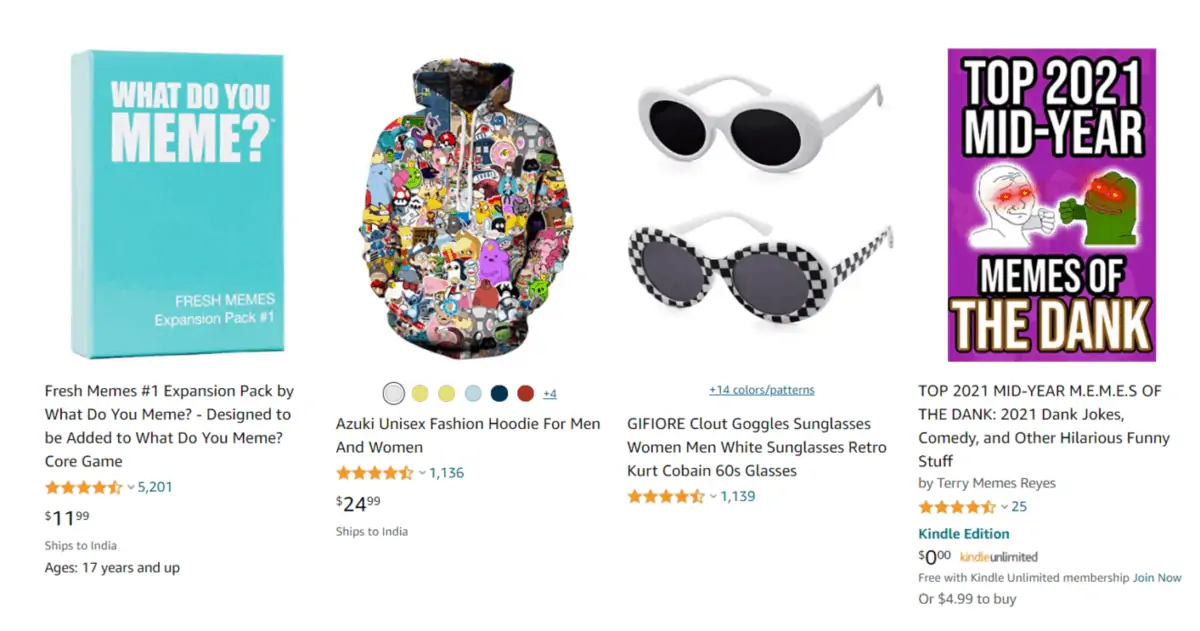
Literally speaking, memes sell – not just on Facebook, but on Amazon too.


Customers buy meme t-shirts, mugs, phone cases, and even pay for books,
courses, trends, and whatnot. These customers include consumers and businesses alike (businesses love to be a part of the trend as well).

Technically, you can categorise meme products into two types – physical products and digital products.

Physical Meme Products

You can actually start an ecommerce brand or a full-fledged ecommerce store to sell meme merchandise like t-shirts, mugs, phone cases, etc. You can either sell these items directly on your site or through third-party marketplaces like Amazon, eBay, Etsy, etc.

But take a note – 

You can’t sell copyrighted material. While memes come under fair use of the copyright law (they can’t sue you for posting memes on Facebook), the copyright owner can sue for making money out of meme merch. But there’s a workaround (not legal advice though):

  1. You can sell merchandise that creates a parody of original memes,
  2. Find memes that are not copyrighted,
  3. Find meme imagery that can’t be copyrighted,
  4. Develop memes with your original imagery.

In simple terms, instead of using the original meme like this –  

woman yelling at cat meme


You sell your merchandise with something like this –


Some of the examples of ecommerce brands that sell meme merchandise are Spreadshirt, Joom, etc.

Digital Meme Products

Meme monetisation isn’t limited to physical products. You can also create digital products like ebooks and courses. These products are super popular among online users and can fetch you good money.

  • Courses: Virality and meme marketing is a topic of interest people do pay to get insights of. You can start a course on websites like Udemy, Skillshare, etc., or start your own course web store to sell your course.
  • Ebooks: If you promise insights on the meme industry and offer the information, trends, insights, or guidance in the form of a book. There’s a market that’s ready to pay for it. 

Meme As A Service Business Model

If you’re good at developing memes but not someone who’d like to start their own meme product business, you can sell your memes as a service. This means you create the memes for clients and charge them for the service. That is, you can either start a meme marketing agency or become a freelancer who develops memes for clients.

  • Meme Marketing Agency: There are agencies that help businesses woo their customers by posting relatable memes on their social media profiles. Some even connect these brands with the masses (micro and nano influencers) who post memes promoting the brand.
Source: Youngun India


  • Meme Freelance Gigs: Businesses, event organisers, and even individuals do pay for memes. You can find thousands of meme-related gigs on Fiverr and other freelancing websites. You can post your gig, but you’d need to have a good portfolio and good ratings to get more and better clients.

Another meme business that you can start is meme design monetisation. That is, you provide designs to the merchandise brands and get a cut when your designed product sells. Several print-on-demand websites like Redbubble, Zazzle, Spring, Spreadshirt, etc. exist that do accept new designers and are more than willing to help you develop your own store and sell on social media and other platforms.

Meme Account Monetisation

If you have a social media profile with good followership, you’re already an influencer who capitalises on your followership in several ways. Usually, you monetise by selling something to your followers or by promoting other accounts, products, and brands on your channel. For sales, you can direct them to different websites using social media features like product tagging, link in bio, etc., or you can directly put the link in your captions or stories. For partnerships and sponsor posts, you can either reach out to potential clients directly or can make them come to you by including a trigger in your bio or description.

  • Affiliates: Affiliate marketing is when you sell other brands’ products to your customers and take commissions for every successful sale. That is, you find a good product, say on Amazon, develop a good-looking creative image, meme, or video and post it along with your affiliate link. Now, you’ll get a commission from Amazon whenever someone buys the product through your link.   
  • Product Sales: You can even start your own brand to capitalise on the huge followership of your meme account. It could be meme-related merchandise or any other brand that you think your audience would love to try and buy. But make sure that your account attracted the audience using memes. So try not to deviate much.
  • Courses: People love to know the secret behind virality and how viral marketing works. If you think you have enough knowledge and good experience to share, people might be willing to pay to learn from you. Just make sure to release your MVP first before investing much in building a course.
  • Sponsored Posts: Your reach matters to many people and brands who would be willing to pay to borrow your followers’ attention. All you need to do is to make the world know that you’re willing to partner, and if you got good reach, you’d get offers. You can also join several influencer marketing agencies like Intellifluence, Join.marketing, etc. to benefit from their agency-level partners.

Meme Content Monetisation

While meme account monetisation requires you to have thousands of followers, you don’t require the same to monetise your meme content. All you need is good-quality content and sound knowledge of search engine optimisation and social media optimisation. 

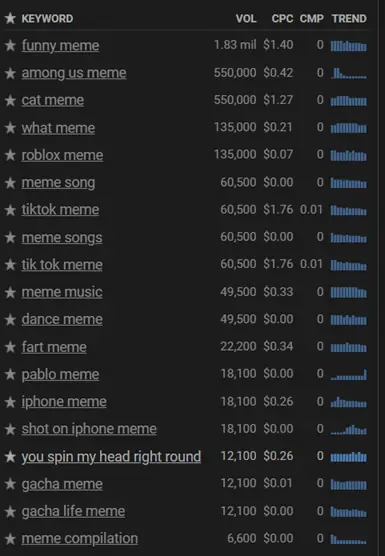
  • YouTube: Meme compilation videos, spoofs, pranks, and meme replies work really on YouTube. Moreover, people do search for meme videos using meme names like “cat meme”, “fart meme”, “yearbook meme” etc. Develop a good video and get enough subscribers to get benefit from the YouTube monetisation program and earn money as a YouTuber. YouTubers usually make $3 to $10 per 1000 video views.
    youtube meme search keywords
  • IGTV: Just like YouTube, you can also make money using meme content if you post long-form videos on Instagram. Though a new feature, Instagram divides the money with IGTV creators.
  • Facebook: Facebook Watch also pays its creators a share of the revenue generated from advertisements. To be eligible, you need to post original videos (that can be meme-related) that are longer than one minute, have more than 10,000 followers, and at least 60,000 minutes of the 600,000 total minutes of your videos viewed in the last 60 days.

Join Platforms That Pay For Memes

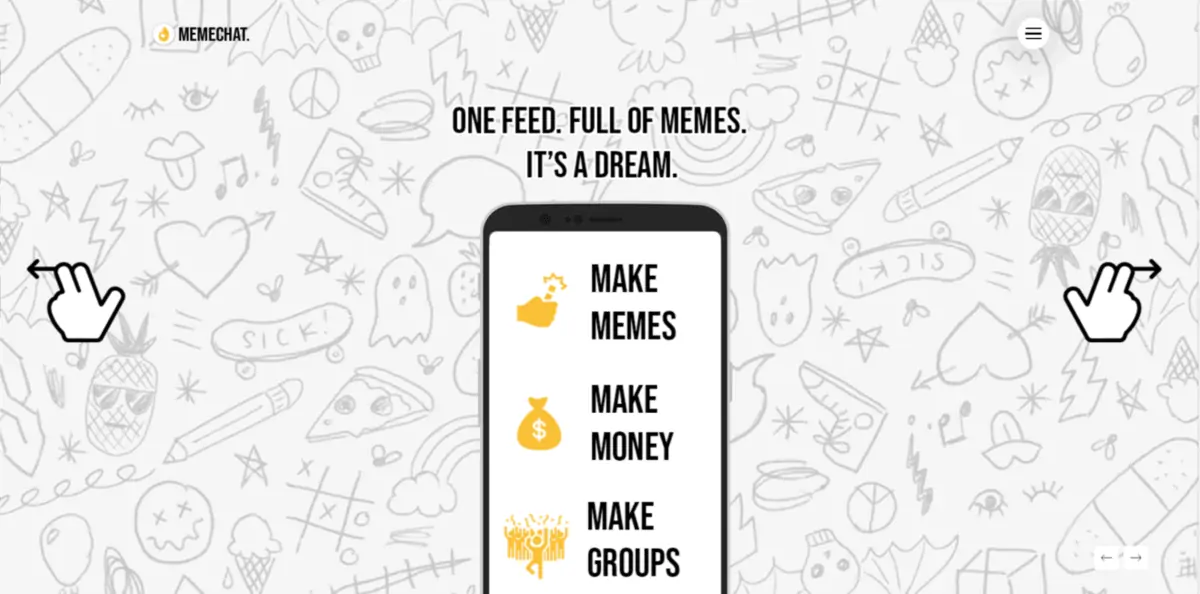
There do exist platforms that pay you for just creating memes for them. Some famous names include MemeChat and PicturePunches. However, while you can rely on such platforms for some extra pocket money, you can’t make a lot using such platforms for now.


Source: Memechat App

Sell Your Original Memes As NFTs

NFTs or Non-Fungible tokens are original works that can’t be replaced. Usually, these are popular imagery, videos, audio, or anything digital that has value.

NFTs operate on blockchain, and memes are now a part of them. In fact, Doge was once a meme. The NFT was sold for $4 million in June 2021.

So, if you’re an original meme content maker, you can sell your memes as NFT if they get famous or start a trend.

How do you sell a meme-art as NFT, you ask?

Well, you’d need a crypto digital wallet, some money in the form of Ethereum, and an account with an NFT platform like Rarible, OpenSea, Mintable, etc. Once done, you need to pay the NFT platform to mint or generate your NFT. You pay the same using Ethereum.

Once done, your meme-art is listed on the NFT marketplace and interested buyers may contact you with their price.

Heads up: Make sure of your meme art’s demand before you convert it into NFT, as you wouldn’t want to pay the minting fees for nothing.

Bottom-Line?

Memes are the lowest hanging fruit in marketing. People love them and they are cheap to create. All you need is a computer, Microsoft Word (or Adobe Acrobat) and you can be making money with these little jokes in less than 15 minutes.

Besides, once you learn the ropes of creating a meme, you can create other original works that have more commercial value. So, go ahead. Make those memes. Make a lot of them. Get creative and sell them. You will be surprised at how well this works!

source


Friday, 13 July 2018

How to Earn Money on Instagram as an Affiliate Marketer


How to Earn Money on Instagram as an Affiliate

Facebook marketing has its merits, but the most recent social media marketing hype for affiliates is now on Instagram.
The app has over 700 million monthly active users, and a staggering 400 million daily users, making it a massive social media portal with massive potential for marketing opportunities.
As an affiliate marketer, your key objectives are to drive traffic to your site by effectively using as many communication channels as possible. Considering the millions of potential customers that you can tap into on Instagram, there are a sea of sales opportunities waiting to happen once you join.
Instagram’s app engagement ranks above Tumblr, Twitter, Snapchat, Pinterest as well as LinkedIn and in addition to being able to gain recognition among relevant niches and market segments, there are plenty of ways to earn money through Instagram which will be covered in the following guide.
How to Earn Money on Instagram as an Affiliate Marketer
Image Credit: TechCrunch

The Ways to Make Money on Instagram

Many are mystified by the concept of Instagram kings and queens who earn thousands a year, sometimes even a month, just by posting pictures of their everyday life (or at least, what they project as what their regular days look like).
While this is believable for celebrities with millions of followers, it can be surprising that having as little as 10,000 followers can earn you up to £15,600 a year, and having 100,000 or more could land you as much as £156,000 annually!
But what is the earning model behind these impressive numbers? Exactly what kind of revenue streams can an Instagram account have and, most importantly, which of these is most relevant for affiliate marketing businesses.

Identifying Revenue Sources for Your Instagram Account

There are quite a few ways you can use the social media app Instagram to make money especially now that Instagram for Business has launched. This can be both directly and indirectly and the difference between these two approaches will be explained briefly below.

Direct Ways to Earn Money on Instagram

As an Instagrammer, you can also earn money by selling the photos you post, or by charging companies for tags, product placement or posts on your page so they can reach your audience (think of it like AdSense).
In other words, direct methods of generating revenue involve a quick and simple exchange of either your audience’s attention or the photos that appealed to your followers. There are, of course, more elaborate and sustainable ways to generate revenue with your account, which we will explain next.

Indirect Ways to Earn Money on Instagram

If selling off your pictures or page’s identity in exchange for a quick buck don’t interest you, then there are other indirect ways to earn money as an aspiring Instagrammer without selling out the identity of your brand and account.
In the same way that you would use a website to funnel in relevant viewers to sell products from publishers, if you are an advertiser that is, you can also use your Instagram account to driver traffic to either the publisher’s product, or to your own site.
There is a lot more to Instagram affiliate marketing, but first you are probably wondering just how ambitious are any of these money-making methods are, and how many followers you would need to get started.

How Many Instagram Followers Do I Need to Earn Money?

When it comes to how many Instagram followers you need to earn money off your account, there are a lot of factors that come into play such as engagement and how many of them are “paid followers”, which we will get into later.
Essentially the number of followers you have and how that affects your account’s ability to earn depends on how you want to make money. If you are interested in advertising for other brands and doing sponsored post then with 3,000 followers or more your starting rate is at $75 a post.
If you are using Instagram to promote your own business or site where your base of operations is, then you should be less concerned with the number of followers and more interested in acquiring loyal and engaged followers who are part of your target market.
Before diving into user engagement and how to track this using Instagram analytics, let’s break down the ways you can earn money on Instagram further:
  1. Earning Money with Instagram Photos
  2. Using Instagram to Earn Money via Affiliate Links
  3. Generating Revenue from Sponsored Posts

Easy Steps to Earning Money from Your Instagram Account

Quite a few methods have been outlined so far in this article, but let’s break it down into quick actionable steps for each method depending on the goals and objectives for your Instagram account.

Earning Money with Instagram Photos

If you are interested in the artistic side of Instagram's commercial potential, then you may want to focus on using the app to find popular niches and create photos for them. Those photos can then be sold on a wide variety of stock image sites (a simple Google search will yield plenty).
Earning Money with Instagram Photos
If you are looking to use Instagram to build a long-lasting and engaged audience rather than make a quick buck off photos, then the choice of images you post are crucial to getting your target market’s attention, which is where the use of hashtags comes in.

Using Hashtags to Generate Likes and Followers

Pretty pictures are important, but without the right tags nobody will see them, nobody will like them, and nobody will learn about your fantastic Instagram page (or the products that you are trying to promote).
And just like that, a potential sale is lost!
There are two schools of thought when it comes to Instagram photo tagging, and depending on your perspective or style, one may work better for your account than the other.
The first view is that you use as many relevant hashtags as possible, which are essentially like targeting keywords for your photo. Unlike a website, visibility on Instagram depends largely on the hashtags you decide to associate with your account’s photos.
Using Hashtags to Generate Likes and Followers
There are quite a few applications and tools to use to come up with the most relevant ones. One example is All Hashtag where you simply enter a keyword that relates to your post and you will get up to 30 hashtags generated (which is Instagram's maximum number allowed per post).
Then there’s the less is more theory:
The opposing view on hashtags suggests that overloading your post with so many tags looks desperate and does not guarantee higher visibility. Advocates of this view claim that have a few well targeted keywords is sufficient and that this also makes your post seem more genuine.
Either way, photos are the key to drawing in an audience, starting from likes that will boost your post and hopefully draw the eye of people interested in whatever you are promoting and start following you.

Using Instagram to Earn Money via Affiliate Links

Not only can you use blog posts and SEO optimized articles to promote products, but whether you are a publisher or advertiser you can take advantage of the Instagram craze in a variety of ways.

Instagram for Affiliate Publishers

Instagram accounts for affiliate publishers are an entirely new network of potential advertisers, and through a simple search you can find some incredible pages that are more than willing to promote your products.
The key is to find accounts with followers that share interests and characteristics with your target market, one efficient way to check this is to look at analytics (there’s more on the subject coming up later in this article) as well as other brands they are affiliated with and if they match with the industry and products you are working with.

Instagram for Affiliate Advertisers

Instagram is a powerful advertising tool, and as an affiliate advertiser you can use a successful account to either drive traffic to your main site, or even as an affiliate advertising page of its own!
The social media app allows tracked links to added to your Bio section or in the description of each post. It is recommended that you shorten the link (try using goo.gl) just to maintain your own brand integrity and avoid making your account look like a shop front.
Assuming you are selling multiple products, you can adjust the hashtags and post photo depending on the product you are promoting, which makes this medium just as flexible and somewhat simpler than optimizing an article or blog post for example.
What if I don’t have enough followers or traffic?
One quick and relatively low cost way of driving traffic to your Instagram account is by purchasing something called a shout-out. This is where you pay a higher ranking influencer, an account with a lot of followers and, ideally, high levels of engagement on the account, to link and endorse your page.
You can choose to approach pages directly by sending a personal message with your proposal, or you can use programs such as Shoutcart, where you can browse accounts to find your niche and, hopefully, potential customers for the product you intend to promote!
How to Earn Money on Instagram: Affiliate Advertisers

Generating Revenue from Sponsored Posts

The number of followers you would need to start diving into Sponsored Postsas a revenue stream starts about 1,000 followers, which marketing experts like Neil Patel believe 5,000 is the number you should have before going there.
Of course, if you aren’t quite there yet you should not ignore the option, but rather start focusing on building up a coherent collection of pictures and improving your hashtag skills. If you are already there then you can start looking for partners.
An important aspect of looking for media partners to promote is that you should avoid supporting brands that are not relevant to your account’s identity. If you are an iGaming affiliate for example, using a gaming Instagram account to sell laxative teas isn’t going to get you far.
The key is to have followers that are relevant to your brand, and if you do want to sell sponsored posts make sure they fit with the image your account is projecting, since Instagram is all about image(s)!

Buying Followers, Boosting Posts and Other Instagram Hacks

Follower apps, generators and other Instagram hacks are extremely saught after. These are particularly of interest to companies and individuals who value how popular their account looks, versus how engaging it is.
Isn’t the whole point of Instagram to engage customers?
While buying an additional 5k followers may make your account seem more legit to a potential customer, it also negatively affects the overall engagement of your account thanks to the formula becoming even more skewed with more followers and less likes and comments (since they are usually fake accounts).
Buying Followers, Boosting Posts and Other Instagram Hacks
In the same way that sending out email marketing campaigns to fake email lists won't work, buying fake followers will not increase sales or even activity on your account as they are usually powered by bots and have no real sales potential.
Also, this will negatively impact your account's analytics!
That’s right, there’s Instagram analytics, and for media partners and experienced professionals, those are the numbers that they’re looking at rather than the follower count on your profile. We’ll explain the key statistics that determine just how good your account is at making money.

Instagram Analytics and the Importance of Follower Engagement

Follower engagement is a term that is thrown around a lot, and it is a fancy term for how many likes and comments each of your posts gets.
Simple enough, right?
Where things get complicated, especially when using hacks and apps to purchase followers and boost that big number on your Instagram page, is that these followers won’t boost any of the engagement stats of your account because they never found your page out of legitimate interest.
You can, of course, purchase Instagram likes, although this whole approach to Instagram is superficial and despite getting you quick results, these likes and followers are unlike to convert to actual customers or revenue.
And the whole point is to make sales!
The only way to earn sustainably is to focus more on attracting relevant followers by investigating hashtags and trends, followed by relevant content generation, rather than buying followers and likes for the sake of seeming more popular than you are.
One way to track your account’s engagement is by using Instagram Analytics tools such as KeyHole, where you get a comprehensive look at which posts people found most interesting. You can also examine other accounts using this tool to get inspired about new posts that work for your audience.
Instagram Analytics and the Importance of Follower Engagement

Things to Consider Before Using Instagram to Earn Money

Taking all this information into consideration, there some crucial steps to successfully earning money on Instagram whether you are an affiliate advertiser looking to expand your reach and content, or a publisher hunting for advertisers on a different media platform.
  1. Choose an identity and be consistent.
  2. Be strategic about hashtags: research!
  3. Collaborate and form partnerships within your niche.
  4. Study your competitors and take notes!
The key to success on Instagram is visual coherence and engaging images.Keep your identity clear and consistent and relevant followers will come!
Approach hashtags in the same way you do keyword research for your website or blog. If you haven’t worked with such mediums then think of it like this: hashtags are like search words, and when tagging you can see how many posts use each hashtag.
What does this mean?
The more posts associated with a hashtag, the more popular the hashtag. However, it is always good to search the hashtag yourself and see what kind of posts are related to it and how similar accounts to yours are approaching that trend.
Aside from spying and learning new tricks, working with related pages is important and the more partnerships you make, and the more likes and comments you put on relevant pages, the more views you will get on your own page.
The beauty of social networks and apps like Instagram is that it is a highly collaborative media outlet, and the best way to have an outstanding and high converting page is to stay dynamic and flexible depending on your audiences interests and feedback.